
Some expenses are too big for one paycheck but too small to justify a trip to the bank. The air conditioner quits in the middle of a Las Vegas July. A dental crown can't wait until next month. You're moving, and the new place wants a deposit before the old one gives yours back.
For a lot of Nevadans, that's the point where a single lump-sum payment on payday just doesn't fit, and they start looking at installment loans in Nevada instead. Spreading the cost over several payments can make the monthly math easier. It can also make the loan more expensive overall, and that trade-off is easy to miss when you're focused on getting through the month.
This guide walks through how installment loans work, how to compare one offer against another, and the specific Nevada rules that apply to installment loans in Las Vegas and the rest of the state. We're a lender-affiliated company, so we'll be upfront: we'd like you to borrow from us if a loan is right for you. We'd rather you understood the costs first.
What an installment loan is
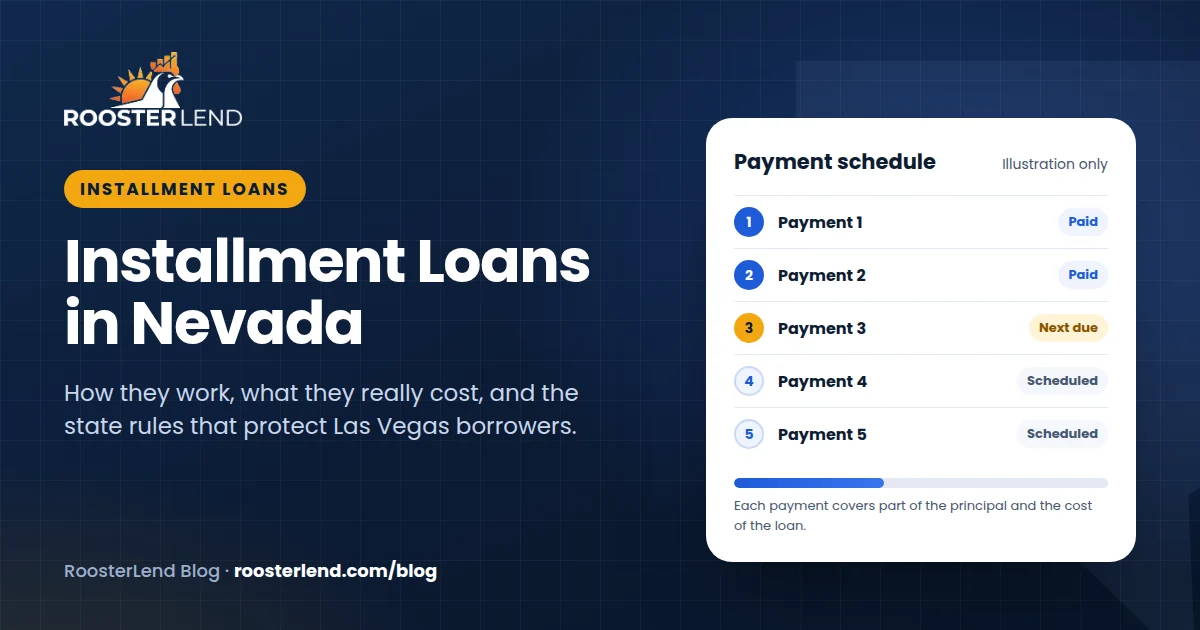
An installment loan is a loan you repay through a series of scheduled payments over an agreed period, rather than all at once. Each payment covers part of the amount you borrowed and part of the cost of the loan, so the balance goes down with every payment until it reaches zero.
Mortgages and car loans are installment loans. So are many personal loans. In this guide, we're talking about the smaller, shorter-term kind that people use for unexpected expenses, the kind you'll see on our installment loans page.
How the payments actually work
When a loan is fully amortizing, every scheduled payment is set so that the last one pays the loan off completely. There's no surprise lump sum waiting at the end.
Inside each payment, two things are happening:
- Part of it pays the cost of borrowing. That's the interest and any finance charges, calculated on the balance you still owe.
- The rest pays down the principal, the money you actually borrowed.
Because the cost is calculated on what you still owe, early payments usually lean more toward interest, and later ones lean more toward principal. That's also why paying a loan off early can save you money: you stop the clock on the remaining balance. In Nevada, you're allowed to do that without a penalty on a high-interest loan, which we'll get to below.
Installment loans vs. payday loans
Both are short-term credit, and both can be expensive. The difference is mostly in how and when you repay.
| Payday loan | Installment loan | |
|---|---|---|
| How you repay | Usually one payment on your due date | Several scheduled payments |
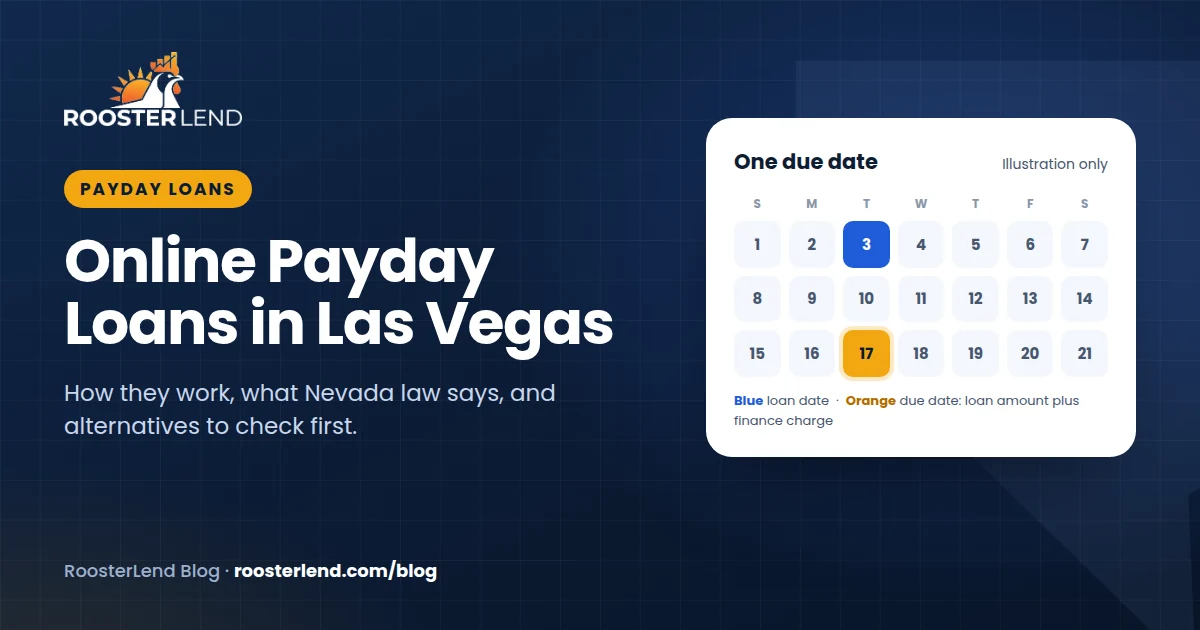
| Each payment | The full amount borrowed plus the finance charge | A portion of the balance plus part of the cost |
| Typical Nevada term | Up to 35 days | Up to 90 days for a high-interest installment loan |
| Biggest risk | Not having the full amount on the due date | Paying more in total because the loan lasts longer |
| Number to watch | Finance charge | Total of payments |
If you're weighing a payday loan instead, our guide to online payday loans in Las Vegas covers that side in detail.
The trade-off: smaller payments, bigger total
Here's the part that's easy to miss. Picture two offers for the same amount financed. One is repaid in four payments, the other in eight. The eight-payment offer has a smaller payment, and it feels easier. But if the rate is similar, you're borrowing the money for twice as long, so you'll usually pay more for it in total.
That doesn't make the longer loan the wrong choice. A payment you can actually make on time beats a cheaper loan you'll default on. It just means you should compare three numbers side by side, not one:
- Payment amount. Can you make it every time, on the date it's due, and still cover rent, utilities and groceries?
- Number of payments. How long will this loan be part of your budget?
- Total of payments. What will you have paid when it's over? Subtract the amount financed and you've got the dollar cost of borrowing, which is the finance charge.
The APR is still useful for comparing two offers against each other. But the total of payments is what actually leaves your bank account.
Nevada rules for installment loans
Which rules apply depends on the loan's rate. Under Nevada law, a loan with an annual percentage rate above 40 percent is a high-interest loan (NRS 604A.0703), regulated under NRS Chapter 604A and licensed and supervised by the Nevada Financial Institutions Division. Short-term installment loans for unexpected expenses usually fall into this category. Loans at or below 40 percent APR are governed by other Nevada lending laws.
Here's what Chapter 604A says about high-interest installment loans.
The term is capped at 90 days
A high-interest loan's original term generally can't be longer than 35 days. It can run up to 90 days if it's an installment loan that fully amortizes, doesn't allow extensions, has no balloon payment and isn't a deferred deposit loan (NRS 604A.5037). Any repayment, renewal, refinancing or consolidation can't stretch the loan past 90 days from the date it was made.
The lender has to check that you can repay
Before making the loan, the lender has to determine that you can reasonably repay it. It looks at your current or expected income, your employment, your credit history, the monthly payment on an installment loan, and other evidence such as bank statements (NRS 604A.5038).
Your monthly payment is capped at 25 percent of your income
A high-interest loan can't require a monthly payment of more than 25 percent of your expected gross monthly income (NRS 604A.5045). If you expect to earn $3,200 a month before taxes, for example, no monthly payment on the loan can be more than $800. That's the legal maximum, not a comfortable target. Most budgets don't have a quarter of their income sitting free.
You can cancel by the next business day
You can rescind a high-interest loan on or before the close of business on the next business day by returning the loan amount, minus any fee charged to start the loan (NRS 604A.505). If you have second thoughts the evening you sign, this is your window.
You can pay it off early with no penalty
You can pay the loan in full at any time without an additional charge or fee, and the lender has to give you a receipt showing the loan is paid in full (NRS 604A.5052).
There are limits on rolling one loan into another
If a new loan is used to pay off an outstanding high-interest loan, the repayment period generally can't be extended more than 60 days past the end of the original loan period, and unpaid interest and charges can't be added to the new loan's principal (NRS 604A.5057). There are narrow exceptions for certain lower-rate, longer-term loans.
Default doesn't mean an immediate lawsuit
Before suing or using arbitration to collect a defaulted high-interest loan, the lender has to offer you a repayment plan. The offer has to stay open for at least 30 days after the default, and the plan has to run at least 90 days unless you agree to something shorter. The lender can ask for a first payment of up to 20 percent of what you owe, but it can't add new fees for the plan, and interest can't exceed the original loan's APR (NRS 604A.5055).
We keep a summary of Nevada's loan rules on our Nevada State Disclosures page. Your loan agreement is the document that governs your specific loan.
How to read an installment loan payment schedule
When you're approved, you'll get a loan agreement with a payment schedule. Before you sign, take five minutes with it:
Find the disclosure box
Near the top, you'll see the APR, finance charge, amount financed and total of payments. Make sure the amount financed matches what you expected to receive.
Do the multiplication
Multiply the payment amount by the number of payments. The result should match the total of payments. If it doesn't, ask why.
Line the dates up with your paydays
If you're paid every two weeks but payments are due monthly, or the reverse, check that each due date lands after money comes in, not before.
Check the first due date
The first payment is the one people most often miss, because it comes before they've settled into the routine.
Ask how payments are collected
If payments come out of your bank account automatically, ask how to change the date or method if you need to.
Read the late and returned payment section
Know what happens, and what it costs, if a payment is late or bounces.
Our loan education page defines every term you'll see, and How It Works shows where the agreement fits in the process.
When an installment loan makes sense, and when it doesn't
An installment loan may be reasonable when:
- The expense is one-time and necessary, like a repair that keeps you getting to work.
- You can't cover the full amount from one paycheck, but you can comfortably fit a smaller payment into each pay period.
- You've checked the cheaper options below and they won't work in time.
It's probably not the right move when:
- You'd be using it to pay off another loan.
- The payment would only fit if nothing else goes wrong for three months.
- The expense will come back next month. A recurring shortfall is a budget problem, and a loan will make it bigger, not smaller.
Our responsible borrowing guide has more questions to work through before you decide.
Warning signs when you shop for installment loans in Las Vegas
- "Guaranteed approval." Nevada requires lenders to assess whether you can repay. A promise to approve everyone means one of those things isn't true.
- Fees before you get the money. Legitimate lenders build their costs into the loan terms. Being asked to pay upfront, especially by gift card, wire or payment app, is a common scam.
- Pressure to refinance before you've finished paying. Repeatedly rolling a balance into a new loan keeps you paying the cost of borrowing without ever finishing. Nevada limits this for a reason.
- Extras added to the loan. If the amount financed includes add-on products, ask whether they're optional and what happens if you decline them.
- A lender you can't identify. Your loan agreement should name the lender. You can confirm a Nevada license with the Financial Institutions Division.
Lower-cost options to check first
- A credit union. Some federal credit unions offer payday alternative loans, which federal rules cap at a 28 percent APR, with repayment terms of up to 12 months on some versions. MyCreditUnion.gov explains how they work. Clark County Credit Union, Silver State Schools Credit Union and One Nevada Credit Union all serve Las Vegas members.
- A payment plan with whoever you owe. Medical and dental offices, utilities and many repair shops will spread a bill out, often at no cost, if you ask before it's past due.
- Your employer. Some offer paycheck advances or hardship help.
- 211. 211 connects Southern Nevada residents with help for rent, utilities and food.
- A nonprofit credit counselor. The National Foundation for Credit Counseling can help you build a plan if this isn't a one-time problem.
See our financial resources page for more.
If you're struggling with payments
- Call the lender before the payment is due. It's easier to adjust a date or arrangement before a payment is missed.
- Consider paying extra when you can. With no prepayment penalty, every extra dollar shortens the loan.
- Know your rights if you default. The lender has to offer a repayment plan before going to court.
- Get free legal help if you need it. The Legal Aid Center of Southern Nevada offers free civil legal help to eligible low-income Southern Nevadans dealing with high-interest loans.
- Report a problem. You can contact the Nevada Financial Institutions Division or the CFPB. Our complaints page explains the steps.
Where RoosterLend fits
RoosterLend is affiliated with a direct lender and offers installment loans and payday loans to eligible borrowers in Nevada, including Las Vegas. Loans are made by the lender named in your loan agreement. If you're approved, you'll see your APR, finance charge, amount financed, total of payments and full payment schedule before you decide, and you're never obligated to accept.
Approval isn't guaranteed. If you've worked through this guide and an installment loan still makes sense, you can review the loan requirements and check your options.
Common questions about installment loans in Nevada
What is an installment loan?
An installment loan is a loan you repay through a series of scheduled payments over an agreed period. Each payment covers part of the amount you borrowed and part of the cost of the loan, so the balance goes down until the final payment pays it off.
How long can an installment loan last in Nevada?
For a high-interest loan, meaning one with an APR above 40 percent, Nevada law allows an original term of up to 90 days if it's a fully amortizing installment loan with no extensions and no balloon payment. Repayment, renewal or refinancing can't extend it past 90 days from the date it was made (NRS 604A.5037).
How much can my monthly payment be on a Nevada installment loan?
A high-interest loan can't require a monthly payment of more than 25 percent of your expected gross monthly income (NRS 604A.5045). The lender also has to determine that you can reasonably repay the loan before making it.
Can I pay off an installment loan early in Nevada?
Yes. You can pay a high-interest loan in full at any time without an additional charge or fee, and the lender must give you a receipt showing the loan is paid in full (NRS 604A.5052).
Are installment loans cheaper than payday loans?
Not necessarily. An installment loan usually has smaller payments, but because you're borrowing for longer, the total of payments can be higher. Compare the payment amount, the number of payments and the total of payments before deciding.
Keep reading
Sources
- Nevada Revised Statutes, Chapter 604A, Nevada Legislature (sections 604A.0703, 604A.5037, 604A.5038, 604A.5045, 604A.505, 604A.5052, 604A.5055 and 604A.5057)
- Nevada Financial Institutions Division
- MyCreditUnion.gov, National Credit Union Administration
- Legal Aid Center of Southern Nevada
This article is general information, not legal or financial advice. Nevada law summaries reflect the statutes published by the Nevada Legislature at the time of writing. Your loan agreement governs your specific loan.